







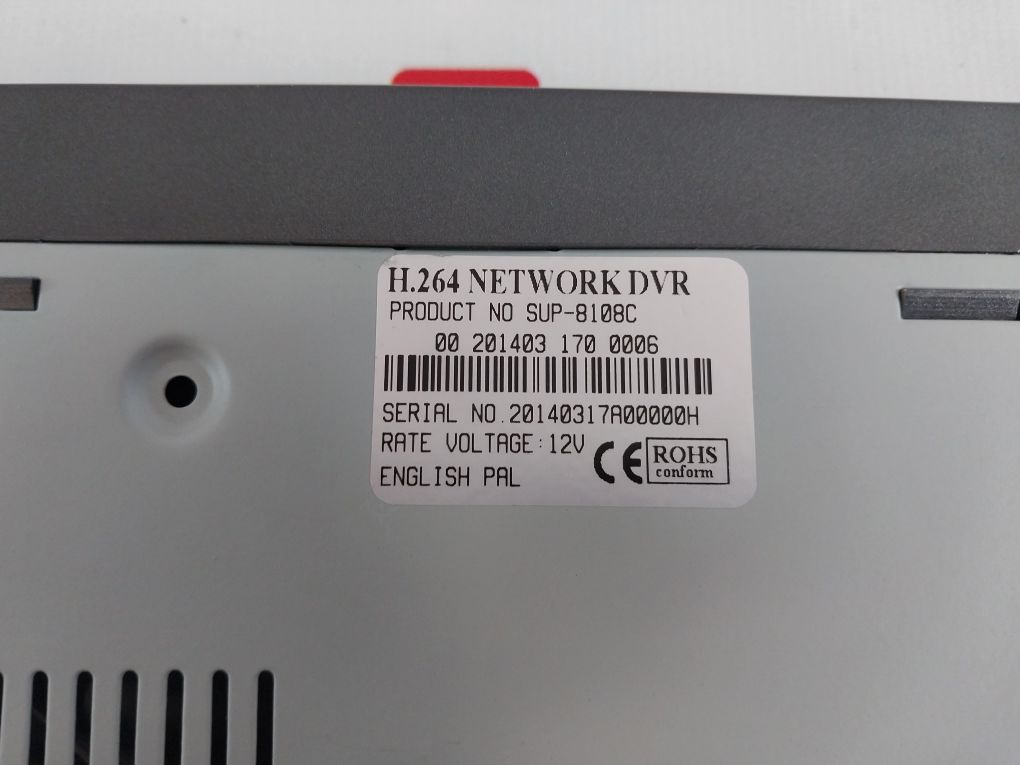

| Attribute | Value |
|---|---|
| Product Name | H.264 Network DVR |
| Video Compression | H.264 |
| Type | Network DVR |
| System | Digital Video Recorder |
| Product No | Sup-8108c |
| Serial Code | 00 201403 170 0006 |
| Rated Voltage | 12V |
| Language | English |
| Video Format | PAL |
| Weight | 2.370 Kg |
| Reference No | 64580 |
What is an H.264 Network DVR?
An H.264 Network DVR is a security tool that captures images from attached security cameras in video format based on the H.264 video standard. This scheme is famous for compressing the size of videos without affecting picture quality, thereby making it excellent for long storage and seamless over-network streaming.
It marries the capabilities of a conventional DVR with the convenience of IP-based networking. It enables users to remotely monitor and control video feeds from a computer, tablet, or smartphone.
Major Features of H.264 Network DVR
H.264 Video Compression
The application of H.264 compression provides high-quality video with a drastic reduction in file sizes, resulting in effective storage and transmission.
Remote Access and Monitoring
Access live streams and stored videos remotely via web browsers or specialized apps. This allows real-time monitoring from anywhere globally.
Multi-Channel Support
The majority of models support 4, 8, 16, or even 32 channels, making it possible to connect and monitor multiple cameras at once.
Motion Detection and Alerts
Smart motion detection features send alerts when unusual movement is detected, keeping you aware and responsive.
Extended Storage Options
DVRs are equipped with internal hard drives and external storage devices, which enable users to record weeks or months of high-definition video.
Easy Integration with Existing Systems
H.264 DVRs support both analog cameras and IP cameras, making it easy to upgrade old security systems.
Uses of H.264 Network DVR
1. Residential Security
H.264 DVR systems are used by homeowners to watch doors, backyards, and living spaces. Remote access is convenient while away from home or working.
2. Retail & Commercial Use
Retailers and business owners rely on these DVRs to prevent theft, monitor customer traffic, and ensure employee safety.
3. Industrial Surveillance
Factories, warehouses, and construction sites use DVRs to oversee operations, monitor equipment, and maintain site security 24/7.
4. Public Safety & Government
Public buildings, schools, and transportation hubs benefit from real-time video surveillance with centralized control capabilities.
Benefits of Using H.264 Network DVR
Storage Efficiency: With state-of-the-art compression, more footage can be stored in smaller drives.
Smooth High-Quality Playback: Smooth and clean video playback with even lessened file sizes.
Cost-Effective: Saves storage, bandwidth, and hardware upgrade costs.
Easy-to-Use Interface: Simple menus and remote control make it easy to use even for non-tech users.
Scalability: Add more cameras or expand storage easily as your needs expand.
How to Choose the Right H.264 Network DVR
When choosing an H.264 DVR, consider the following:
Number of Channels Needed
How many cameras do you plan to connect? Choose a DVR with sufficient channels for present and future requirements.
Storage Capacity
Have sufficient hard drive capacity or allowance for external storage for extended recording.
Remote Access Capability
Select a system that accommodates your preferred remote viewing technique—app, browser, or software.
Camera Compatibility
Verify your current cameras (analog or IP) are supported.
Technical Support & Warranty
A system with good customer service and warranty provides long-term value.